Published on January 21, 2026
Religion is a spiritual phenomenon that has played a dominant role in the socio-political organisation of man throughout history. The evolution of ancient states and nations from theocracy points to the fact that religion is an inseparable feature of the modern state. However, religion, despite being part of Nigeria‟s social system, has become dangerously fused into the country's body politic and has become a major centrifugal force threatening it. Strikingly, the core tenets of religion have been polluted with dogma that supports the perpetuation of the elite in power.
Religion, according to Iwe, “…is essentially and fundamentally a spiritual issue and exercise. It arises from man‟s consciousness and practical acknowledgement of His dependence on God (the absolute and ultimate reality) and from His search for answers to the basic universal non-material issues of human existence” Iwe (2000). The above, when juxtaposed with the practice of religion in Nigeria, reveals the opposite.
The correlation between religion and conflict, though a contested one throughout human history, never rears its ugly head as a potent threat to national integration in the formative years of the Nigerian state. However, when culture, ethnicity and regionalism were manipulated in the struggle for scarce social goods and wants, religion assumed a different dimension in the national life of Nigeria as suspicion and division along religious divide became controversial. As noted by Best (2011), the contentious posture of religion in Nigeria today cannot be divorced from the colonial heritage of the country. For instance, the colonial administration through Indirect Rule System promoted the Emirate and Koranic educational systems and never altered the prevailing religious and cultural practices of the North. This development, in part, is responsible for the rejection of the secularity of the Nigerian state by the northern oligarchy. This has concomitantly led to the proliferation of religious sects and the sharp rise in extremism and fundamentalism in the northern region of Nigeria with its attendant consequences on peaceful coexistence and cohesion.
Religious fanaticism, which is the trademark for political mobilisation in Nigeria, gravely shatters the very fabric upon which Nigeria was founded; this is consequent upon the fact that Nigeria is a secular state as enshrined in section 10 of the 1999 constitution as amended. It is an irrefutable fact that our leaders view themselves first as either Muslims or Christians than Nigerians.
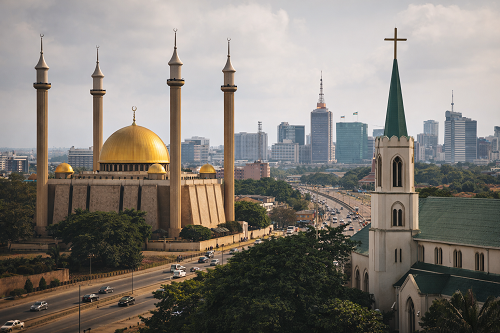
James Hitchrock is apt to state that “…the danger of strife and fanaticism comes from the very nature of religion itself, which deals with ultimate things, in a sense people ought to be more ready to fight over religious dogma than over disputed territory, because religious dogma has to do with the highest and most important truths”. (Hitchrock, 2001: 49). Consequently, the proliferation of mosques and churches in Nigeria put together outnumber social amenities.
Another striking feature of the religious problems in Nigeria is that, put together, they correspondingly fall within a period associated with the oil boom. Specifically the violent interreligious conflicts openly manifested themselves in the mid-1980s which corresponded with the introduction of the Structural Adjustment Programme (SAP) in Nigeria as the clinical medication prescribed by the World Bank and International Monetary Fund consultants for ailing economies. This programme itself brought serious hardships, as it required adjustment in various aspects of life both at the individual and institutional levels. On the average, the general effect of Structural Adjustment Programme (SAP) was: “Mounting unemployment, soaring inflations, poor public transportation, under-utilisation of installed capacities in the industries and agriculture, and a decline in the standard of living…..”(Obasanjo in Newswatch August, 1988:18).
This traumatic experience had a significant effect on the psyche of the Nigerian. The tendency was to resign to fate and become more religious as it is typical with the helpless when faced with a terminal problem. This lends credence to the position of Marx and his doubts about religion when he summarised it as the “sigh of the oppressed creature”. Thus, the sudden religiosity of both Christians and Muslims in Nigeria resulted to revivalistic attitudes. For the Christians, it was the “Born again” movement and for the Muslims, it was Islamic fundamentalism. The Nigerian state was not ignorant of these happenings. It was mindful of the role religion had come to play in the lives of Nigerians, in these trying moments as noted by (Gofwen, 2001). The leadership therefore employed it as an instrument of manipulation, and perfected the politicisation of religion. As Chafe noted (1992:19):
“Since the inception of SAP, the Babangida regime went out of its way to, in a systematic and organised manner, silence all popular and democratic organizations that are capable of challenging its harsh policies. However, the regime had, on the other hand, extended support and a lot of its patronages to religious organizations such as the Jamaátu Nasril Islam (JNI) and the Christian Association of Nigeria (CAN)….a development, which has, more than ever before, promoted a culture of religious bigotry” (Cited in Gofwen, 2001: 46).
A devastating aspect of this was that religious consciousness and inter-religious suspicion got to its climax in Nigeria. This permeated all facets of the system as activities and actions were interpreted through the prism of religion. These were clearly reflected in the religious activities in some educational institutions, the indiscriminate building of mosques and prayer grounds at public and official residential areas of public servants and top government officials, the lop sidedness of government appointees into various positions nationally. As a resultant consequence, religious groups and issues evolved from a relatively obscure position to a formidable and prominent one thereby earning Nigeria the reputation of being commonly:
“Listed among countries in which the chances of a religious war are quite high. And by „religious war‟ observers have in mind not the Maitatsine kind of limited religious eruption but a major political catastrophe springing from religious differences across the country...” (Ubah, 1984: 4). The Boko Haram menace that has plagued the country for over a decade is a testament to the opinion expressed above.
No comments yet. Be the first!
Leave a Comment